


Online Offer
Feel free to contact us with any questions or requests for additional information. We are here to provide you with the best service!

Pre Cooling

Pre Cooling
Why Evaporative Pre-Cooling?
Today, in most comfort and industrial facilities, air-cooled condensers are used in air conditioners, dry coolers, and chiller units.
Ambient air is used to cool the condenser. The performance of air-cooled air conditioners, dry coolers, and chiller units depends on the dry-bulb temperature of the ambient air. When the outdoor air temperature increases, the capacity of these systems decreases. A significant loss occurs in heat transfer from the refrigerant to the outdoor air. This leads to higher electricity consumption and reduced cooling capacity. As a result, air conditioners, dry coolers, and chiller units consume more energy and operate for longer periods to meet cooling demands.
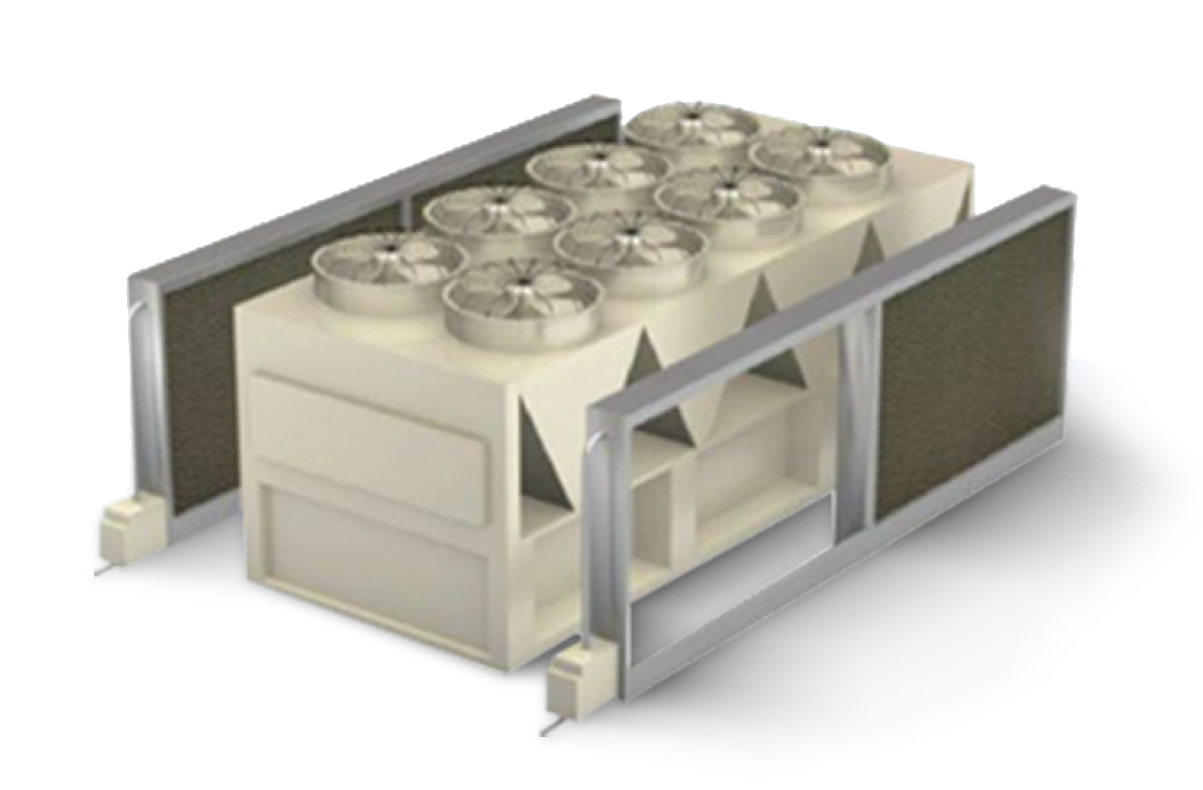
This problem can be solved by adding a pre-cooling system in front of the air-cooled condenser. This technology is known as evaporative pre-cooling. The evaporative pre-cooler reduces the load on air conditioners, dry coolers, and chiller units by cooling the air surrounding their condensers.
Evaporative pre-coolers allow air conditioner, dry cooler, and chiller condensers to operate more efficiently at high temperatures, resulting in increased cooling capacity, reduced electricity consumption, and extended compressor lifespan.
Increase in Cooling Capacity
Every 1°C decrease in the air temperature entering the condenser provides a 1% increase in cooling capacity.
A 10°C difference provides a 10% increase in capacity.
Increase in cooling capacity.
Decrease in electricity consumption.
Increase in compressor life.

Increased Compressor Life
Operating the compressor at lower pressure extends the life of the compressor.
Decrease in Energy Consumption
Every 1°C decrease in air temperature entering the condenser provides a 2% decrease in energy consumption.
A 10°C difference provides 20% energy savings.
Decrease in electricity consumption.
Increase in compressor life.

Total Earnings
10°C Temperature Difference;
10% increase in capacity
19% saving in energy consumption
25% increase in COP.

Pre Cooling
Why Evaporative Pre-Cooling?
Today, in most comfort and industrial facilities, air-cooled condensers are used in air conditioners, dry coolers, and chiller units.
Ambient air is used to cool the condenser. The performance of air-cooled air conditioners, dry coolers, and chiller units depends on the dry-bulb temperature of the ambient air. When the outdoor air temperature increases, the capacity of these systems decreases. A significant loss occurs in heat transfer from the refrigerant to the outdoor air. This leads to higher electricity consumption and reduced cooling capacity. As a result, air conditioners, dry coolers, and chiller units consume more energy and operate for longer periods to meet cooling demands.
This problem can be solved by adding a pre-cooling system in front of the air-cooled condenser. This technology is known as evaporative pre-cooling. The evaporative pre-cooler reduces the load on air conditioners, dry coolers, and chiller units by cooling the air surrounding their condensers.
Evaporative pre-coolers allow air conditioner, dry cooler, and chiller condensers to operate more efficiently at high temperatures, resulting in increased cooling capacity, reduced electricity consumption, and extended compressor lifespan.
